Skip to content
Top-rated outdoor gear, ranked

Best Of 2026

Best Homestead Greenhouses of 2026

Our top 12 picks, independently ranked. Budget to premium.

Greenhouse shopping splits into two worlds that barely talk to each other. On one side sit backyard kit brands selling walk-in structures measured in square feet, sold through Amazon and big box stores, optimized for a patio and a few tomato plants. On the other sit commercial growers buying tunnels measured in bed-feet, quoted by phone, shipped by freight from a steel shop. Homesteaders and small farms live in the gap between them, and that gap is exactly where the shopping advice runs out.

The useful way to think about the decision is cost per covered square foot against expected service life. A $270 hoop cover gives you roughly 200 square feet of frost protection that will last one or two seasons before the cover shreds. A $1,582 caterpillar tunnel gives you 280 square feet of real growing ground with steel that outlives several covers. A $4,000 twin-wall polycarbonate house gives you 96 square feet you can work in during a January snowstorm. A $10,000 glass house gives you 80 square feet that will still be standing when your grandchildren inherit the place. All four are correct answers to different questions, and the mistake most people make is buying the last one when they needed the second one.

One more thing worth knowing before you spend: in the United States, the NRCS EQIP program cost-shares high tunnels on working farms, which is why so many commercial tunnels are sold in 30 by 72 configurations. That single fact reshapes the math for anyone running an actual agricultural operation, and it is invisible on any retail product page.

At a glance

#ProductPrice
1$1,580–$3,600
2$4,050–$5,000
3$1,700–$2,400
4$530–$3,740
5
Nor'Easter Greenhouse

Rimol Greenhouse Systems

$9,250–$19,000
6$3,400–$6,000
7$3,830–$20,400
8$750–$1,100
9$2,780–$8,100
10$2,700–$8,200
11$9,800–$13,000
12$250–$370
Gothic Caterpillar Tunnel
Best OverallMid-range

1. Gothic Caterpillar Tunnel

Farmers Friend

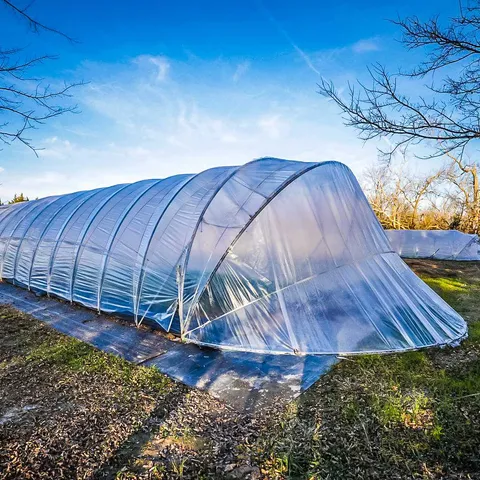
$1,580–$3,600

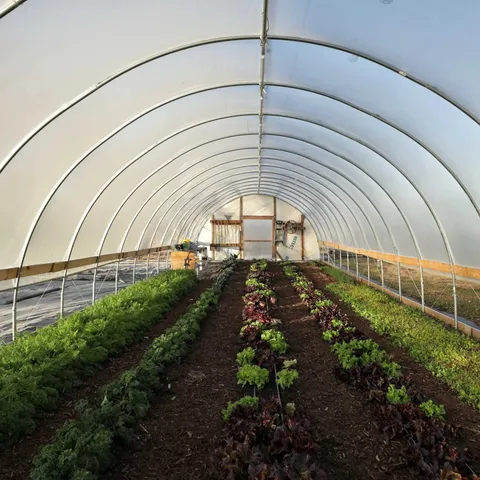
The base 14 by 20 kit is $1,582 with free shipping, which puts 280 square feet of protected ground under 14-gauge steel for less than most 8 by 8 polycarbonate kits cost. For homesteaders and market gardeners it is the highest-leverage structure on this list.

Best for: Anyone who wants the most protected growing ground per dollar and can live without winter glazing.

14-gauge steel bows and a steel center purlin, roughly 40% thicker than the previous generation · Gothic peak sheds snow far better than a round hoop profile · Standard package assembles in 3 to 4 hours, so a weekend covers the crop · 5-year storm damage warranty and a 4-year rated 6 mil cover

Rope and batten sides need seasonal retensioning, and most owners pull the plastic before heavy winter snow · It is a season extender, not a heated four-season house · The 16-foot-wide configurations sell out and go unavailable for stretches
MONT Greenhouse 8' x 12'
Editor's PickPremium

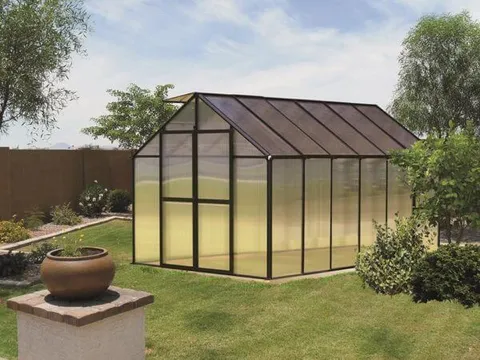
2. MONT Greenhouse 8' x 12'

Riverstone

$4,050–$5,000

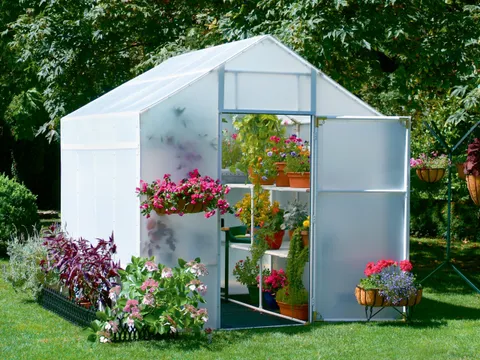
8mm twin-wall polycarbonate on a heavy extruded aluminum frame, made in the USA and backed by a 10-year warranty on both frame and glazing. This is the walk-in kit to buy if you actually intend to work in it in January.

Best for: Homesteaders in cold climates who want one permanent structure that works year round.

8mm twin-wall polycarbonate on roof and walls, genuinely insulating rather than merely transparent · 10-year warranty on frame and panels, the longest among rigid-glazed kits at this size · 4 by 6 foot double door opening takes a wheelbarrow, which most hobby kits cannot · Two roof vents ship with automatic openers, plus an integrated dual gutter system

Assembly realistically takes a full weekend with two people · Roughly four times the price of a single-wall kit with similar floor area · Needs a properly leveled and squared base before the frame goes up

Snap & Grow 8' x 12' Greenhouse Kit
Best ValueMid-range

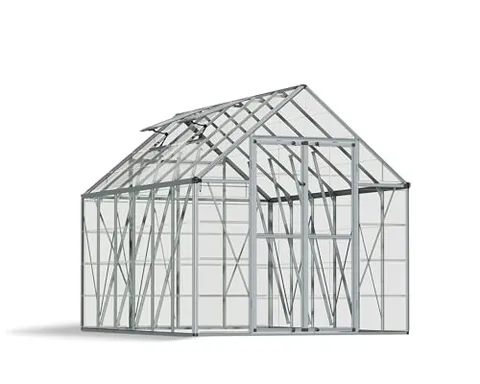
3. Snap & Grow 8' x 12' Greenhouse Kit

Palram Canopia

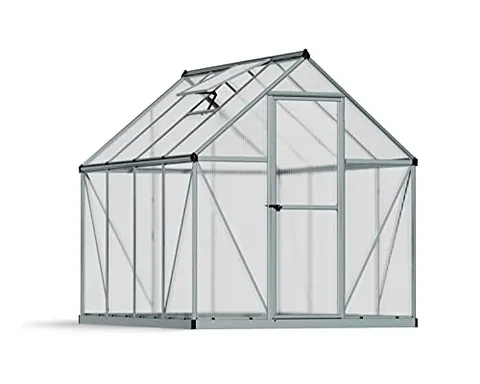
$1,700–$2,400

Just under 100 square feet of walk-in space for well under $2,000, with a SmartLock connector system that most buyers finish in an afternoon. It is the sensible first permanent greenhouse for a homestead that has outgrown hoops.

Best for: Buyers who want maximum walk-in square footage per dollar in a permanent rigid kit.

Close to 100 square feet of floor area at roughly a quarter the cost of twin-wall kits that size · SmartLock assembly is realistically a 4 to 5 hour job, not a weekend · Panels transmit over 90% of light while blocking UV, which suits transplant raising · Wide double hinged doors at 45.5 inches make hauling flats in and out practical

Panels are 0.7mm single-wall polycarbonate, so it holds almost no heat overnight · Rated to 56 mph wind and 15.4 lbs per square foot snow load, which is modest for northern sites · Anchoring is not optional, and the galvanized base is worth adding

DIY High Tunnel Greenhouse Kit, 12 ft Wide
Best BudgetBudget

4. DIY High Tunnel Greenhouse Kit, 12 ft Wide

Bootstrap Farmer

$530–$3,740

Starting at $528.99, this ships the hardware that is hard to source (ground posts, cross connectors, spring wire, lock channel, plastic) and expects you to buy lumber and top rail at the local farm store. That split is what makes 240 square feet cost about the same as a patio kit.

Best for: Handy homesteaders who want serious growing area and are comfortable sourcing lumber locally.

Lowest real cost per covered square foot of anything here · Ships in 1 to 2 business days from Texas, made with 90% domestic content · Spring wire and lock channel included, which is the difference between a tunnel that holds plastic and one that does not · Scales from 20 feet to 100 feet on the same hardware pattern

Not a complete kit, since lumber and 1 3/8 inch top rail are bought locally and add real cost · 8 foot center height on the 12 foot width is cramped for tall trellised crops · You are the general contractor, and the instructions assume some fluency with hand tools

Nor'Easter Greenhouse
Best PremiumPremium

5. Nor'Easter Greenhouse

Rimol Greenhouse Systems

$9,250–$19,000

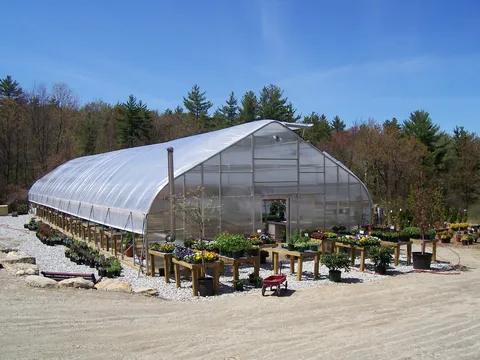
A truss assembly on every bow, 1.90 inch 13-gauge galvanized steel, and engineering that meets or exceeds International Building Codes. The 30 by 72 at $12,834 is the configuration market gardeners buy because it fits inside the NRCS payment cap.

Best for: Working farms and agritourism operations in snow country that need a code-grade structure.

Truss on every bow, which is why it holds snow loads that flatten lighter tunnels · Published pricing by size, from $9,252 for the 30 by 48 up to $18,992 for the 34 by 96 · NRCS approved in base configuration, so it works with EQIP cost-share · Wind bracing kit included as standard, not sold as an upgrade

Freight, site prep, and installation are real costs on top of the kit price · 30 feet wide is far more structure than a household garden needs · Automated vents, roll-up sides, fans, and controllers are all separate line items

Garden Master Greenhouse
Mid-range

6. Garden Master Greenhouse

Solexx

$3,400–$6,000

Solexx uses a flexible double-walled polyethylene panel instead of rigid polycarbonate, hitting 2.1R at 3.5mm and 2.3R at 5mm. The light it lets through is fully diffused, which is why it has a following among growers raising transplants.

Best for: Cold-climate growers starting transplants who value insulation and diffuse light over clarity.

Real insulation value at 2.1R to 2.3R, which is unusual outside twin-wall polycarbonate · Fully diffused light avoids the hot spots and scorch that clear panels create · Composite frame does not rust, corrode, or mildew, and carries a 10-year warranty · Bench frames rated to 500 lbs each and hanging rods to 200 lbs each are included

Pricing swings widely between retailers and configurations, so shop it carefully · Panels are translucent rather than clear, so you cannot see plants from outside · 5mm panels are effectively required at altitude or under heavy snow, and cost more

Gothic All-Metal High Tunnel Kit
Premium

7. Gothic All-Metal High Tunnel Kit

Bootstrap Farmer

$3,830–$20,400

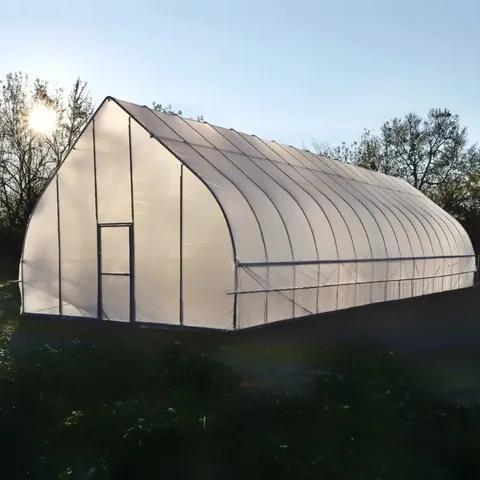
An all-metal end wall design that removes wood rot from the equation entirely, on a gothic profile built for northern snow. The 11 foot 4 inch width starts at $3,832.99 and the line runs up to a 20 by 100 at $20,399.99.

Best for: Small farms in northern climates that want a permanent tunnel with no wooden end walls.

All-metal end walls with a prefabricated 36 inch door, so nothing rots out in five years · Integrated wind bracing at seven lateral points along the structure · Steep gothic roofline sheds snow instead of collecting it · 20 foot model reaches 15 feet 8 inches at peak, enough for tall trellised crops and equipment

A serious build, and freight on the larger configurations is substantial · Purlin and corner bracing kits only come with the 14 and 20 foot widths · Overkill for anyone growing for a single household

Mythos 6' x 8' Greenhouse Kit
Budget

8. Mythos 6' x 8' Greenhouse Kit

Palram Canopia

$750–$1,100

The 4mm twin-wall panels and galvanized steel base put this a real step above the sub-$500 kits, and it stays under four figures at most retailers. It is the right size for hardening off transplants and overwintering tender perennials.

Best for: First-time greenhouse owners who want a rigid, permanent structure without a four-figure commitment.

4mm twin-wall polycarbonate holds more heat than the single-wall panels used in cheaper kits · Galvanized steel base is included rather than sold separately · Integrated rain gutters make water capture straightforward · Lockable door with magnetic catch, and a 5-year limited warranty

Only one roof vent, and the automatic opener is an extra purchase · 48 square feet fills up fast, and most owners wish they had gone bigger · Same 56 mph wind and 15.4 lbs per square foot snow rating as the larger Palram kits

All-Metal Caterpillar Tunnel Kit
Mid-range

9. All-Metal Caterpillar Tunnel Kit

Bootstrap Farmer

$2,780–$8,100

The butterfly doors are the reason to pay more than the Farmers Friend kit costs. A clamshell design at each end removes the daily ritual of bunching loose plastic and tying it to a stake, which matters when you are opening and closing every day for months.

Best for: Growers who open and close a tunnel daily and want doors that do not fight back.

Butterfly doors eliminate the constant tying and untying that defines most caterpillar tunnels · 16-gauge US steel hoops with triple-layer zinc, conversion coating, and polymer protection · Made in Texas with 82% domestic content, ships in 1 to 2 business days · 14 and 20 foot widths, with center heights of 9 feet 4 inches and 11 feet 4 inches

Starts at $2,777.99 for the 14 by 20, roughly 75% more than the comparable Farmers Friend kit · Ships motor freight, so plan for a delivery you can unload · Still a caterpillar tunnel, so plastic comes off before serious winter snow

Traditional Greenhouse
Premium

10. Traditional Greenhouse

Yoderbilt

$2,700–$8,200

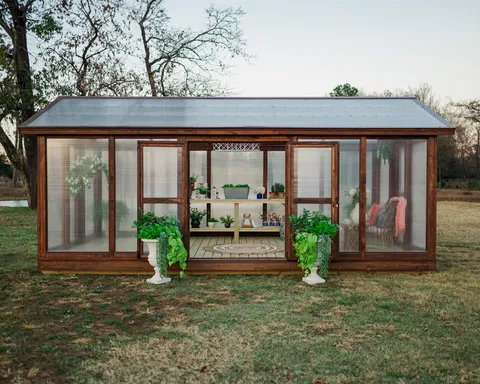
Handcrafted, delivered fully assembled, and set in its permanent location by the delivery crew, which is a genuinely different proposition from every kit on this list. The 11 by 20 starts at $8,195 and the line opens at $2,695.

Best for: Agritourism operators and homesteaders who want a finished, attractive building with no build phase.

Arrives fully built and placed, so there is no assembly weekend at all · Timber-framed construction reads as a farm building rather than a plastic box, which matters for agritourism sites · Financing and rent-to-own are offered, which suits operations with seasonal cash flow · Published starting prices by size rather than quote-only pricing

You pay a large premium for assembly and delivery compared with a kit of similar floor area · Delivery requires access for a trailer and clear approach to the site · Prices rose after a June 2026 increase, so confirm current figures before budgeting

Royal Victorian VI 23 Greenhouse
Premium

11. Royal Victorian VI 23 Greenhouse

Janssens (Exaco)

$9,800–$13,000

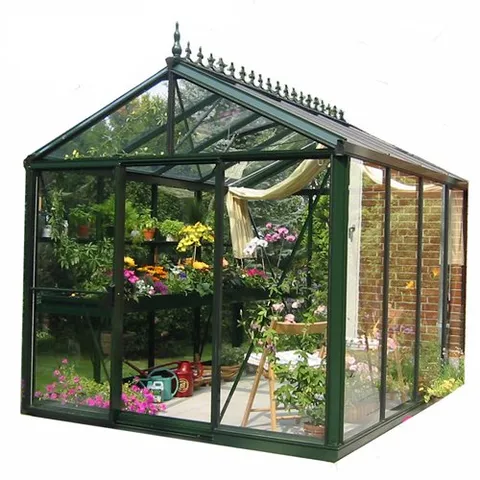
Belgian-made, 4mm tempered safety glass on a heavy aluminum frame, with a 15-year warranty on frame and glass. It is the most expensive structure per square foot here by a wide margin, and it is on this list because a photogenic glass house earns its keep on a farm that sells experiences.

Best for: Agritourism operators for whom the greenhouse is part of the guest experience, not just production.

4mm tempered safety glass with a 15-year warranty on both frame and glazing · Two roof vents, one automatic, plus an automatic louver window with a Lexan cover · 6 inch integrated foundation frame with a 4 inch threshold, so it sits properly on a footing · Genuinely a lifetime structure, and it looks the part in wedding and farm-stay photography

Roughly $9,800 for 79 square feet, which is over $120 per square foot of floor · 994 lb shipping weight and a required foundation put this beyond a weekend project · The 28 inch sliding door is narrow for hauling flats or a wheelbarrow

20' x 10' x 7' Walk-in Tunnel Greenhouse
Budget

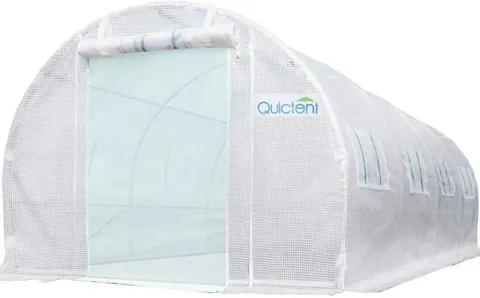
12. 20' x 10' x 7' Walk-in Tunnel Greenhouse

Quictent

$250–$370

Two hundred square feet of covered ground for the price of a decent chainsaw. Treat it as a two to three season consumable rather than a structure, and it is a reasonable way to find out how much greenhouse you actually need.

Best for: Anyone testing whether they want a greenhouse before committing four figures to one.

200 square feet of covered space starting near $254 at the manufacturer · Two-layer PE cover with reinforcement mesh, roughly 85% light transmission · Screen mesh door and multiple window vents, which most cheap covers omit · Goes up in a couple of hours with no site prep and no foundation

The cover is the failure point, and 2 to 3 seasons is a realistic life in sun and wind · Steel tube frame will bend under snow load, so it needs to come down before winter · Anchoring is the whole game, and an unanchored one will end up in the neighbor's field

How we choose

We built this list by pricing real, currently orderable models across four structure types (film hoop tunnels, caterpillar tunnels, commercial gothic high tunnels, and rigid-glazed walk-in kits), then ranking them on covered square feet per dollar, glazing and frame spec, snow and wind ratings where the manufacturer publishes them, warranty length, and how realistic assembly is for one or two people. Prices were pulled from manufacturer sites and specialist retailers rather than from marketplace listings, because greenhouse street pricing swings hard with freight. The budget tier covers structures under roughly $1,100 that trade permanence for immediate season extension. The mid tier runs from about $1,400 to $3,500 and buys either serious growing area in film or a solid walk-in kit. The premium tier starts around $4,000 and buys either commercial steel engineered to code or a rigid-glazed house rated to work through winter. We bought nothing, accepted nothing, and have no relationship with any manufacturer named here. Where a product has a real weakness, it is listed in the cons.

Common questions

If you have a farm number and a working agricultural operation, the USDA Natural Resources Conservation Service cost-shares seasonal high tunnels through the EQIP program. That is why commercial tunnels are so often sold in 30 by 72 and 30 by 96 configurations, since those sizes tend to land near the payment cap. Rimol explicitly markets its 30 by 72 Nor'Easter to growers using NRCS funding. Applications go through your local NRCS field office, the structure has to be built to their standard, and approval usually has to come before you build. Backyard hobby kits do not qualify.

Poly film (6 mil, typically warrantied 4 years) is the cheapest cover per square foot by a wide margin and it is what nearly every working farm uses. You re-cover every few years and accept that. Twin-wall polycarbonate is the sweet spot for a permanent walk-in house, since 8mm twin-wall holds meaningful heat, diffuses light, and shrugs off hail that would shatter glass. Single-wall polycarbonate, which is what most sub-$2,000 kits actually use, transmits light beautifully and insulates almost not at all. Glass is the most durable and the most beautiful, it is also the heaviest, the most expensive, and the one that requires a real foundation.

Buy roughly twice what you think you need. The most common regret in greenhouse ownership is a 6 by 8 that filled up in the first spring. For a household growing its own food, a 8 by 12 walk-in kit or a 14 by 20 caterpillar tunnel is a realistic starting point. For anyone selling at a market or running a farm stand, start at 20 feet wide, because narrower tunnels waste an enormous fraction of their footprint on unusable edges where the roof comes down.

An unheated structure buys you roughly one to two USDA hardiness zones of protection, which for most of the country means hardy greens all winter and a four to six week jump on spring transplants. That is enough for most homesteads. Heating changes the economics completely, because a single-wall polycarbonate or film structure is essentially uninsulated and propane goes straight out through the glazing. If you intend to keep a structure above freezing through a northern winter, buy insulated glazing (8mm twin-wall polycarbonate or 5mm Solexx at 2.3R), not a bigger heater.

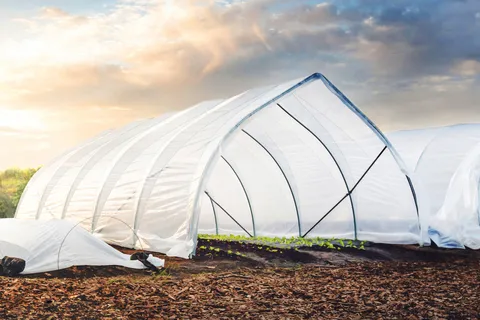
A caterpillar tunnel uses lighter bows with the plastic held on by rope run over the top and tied to ground anchors, which is why it costs a fraction of a high tunnel and goes up in an afternoon. A high tunnel uses heavier gauge steel, purlins, wind bracing, and lock channel with spring wire, and it is engineered to stay covered through winter. If you are in snow country and want the structure covered in January, buy the high tunnel. If you want maximum protected ground for a spring through fall season and are willing to pull plastic before winter, the caterpillar tunnel is the better value by a large margin.

Film tunnels use driven ground posts, typically 2 to 3 feet into the soil, and need no concrete at all. That is a real advantage on a homestead, because it keeps the structure classified as temporary in many jurisdictions and lets you site it on ground you have not leveled. Rigid-glazed kits need a flat, square, level base, and most manufacturers sell a galvanized base frame or expect a treated timber or gravel perimeter. Glass houses like the Janssens need the most, usually a poured perimeter footing. Check your county before you order anything permanent, since setback and permit rules for a fixed greenhouse differ from those for a hoop structure.

Some links are affiliate links, and we may earn a commission at no extra cost to you. It never affects our rankings.

In your pocket

Take farm country with you.

Free, no account needed. Farm maps, season checklists, and the crop identifier in your pocket.

  • Every farm stand and u-pick in your pocket

  • Plan a multi-stop farm day and save it

  • Snap a photo. AI names the crop

  • GPS tracking that keeps recording down the county road

The Farm Country Hubs app dashboard

For operators

Run a farm business?
Get on the map for free.

Claim your free listing for a branded page and a spot in the Farm Country Hubs app, then add bookings and digital waivers whenever you’re ready. No setup cost.