Skip to content
Top-rated outdoor gear, ranked

Best Of 2026

Best Homestead Chainsaws of 2026

Our top 12 picks, independently ranked. Budget to premium.

A homestead chainsaw does a different job than a suburban one. You are not tidying one storm limb a year. You are dropping standing dead ash for next winter's firewood, clearing blowdown off a fence line before the cattle find the gap, bucking a windthrown maple that came down across the lane on an event weekend, and occasionally squaring a beam for a shed. That work rewards a saw you can rebuild instead of replace, a bar length matched to the trees you actually have, and a dealer close enough that a broken recoil spring costs you an afternoon rather than a season.

The market has genuinely split, and the split is useful. Gas still owns felling and firewood work in wood above roughly 16 inches, and a 50cc to 60cc rear-handle saw remains the single most useful powered tool on most small farms. Battery has quietly taken everything else. For agritourism operators the noise argument outweighs the spec sheet: a cordless saw lets you clear a trail at 7 a.m. without waking the cabins, it starts instantly after sitting three weeks, and it will not stink up a barn you are about to seat forty people in. Plenty of properties are best served by owning one of each rather than one compromise saw.

Price tells you more about construction than about power. Under about $250 you are buying a homeowner saw with a clamshell crankcase, a plastic-heavy build, and a service life measured in cords rather than years. From roughly $450 to $600 sits the farm and ranch class, which is where most homesteads should shop. Above $700 you reach professional saws: magnesium crankcases, genuine rebuildability, real anti-vibration mounts, and 20 to 30 percent more power for every pound you carry. That last jump is not about cutting faster. It is about being able to cut all day and still want to cut tomorrow.

At a glance

#ProductPrice
1$479–$559
2$449–$489
3$700–$780
4
455 Rancher

Husqvarna

$450–$550
5$449–$549
6
450 Rancher

Husqvarna

$320–$400
7$690–$780
8$810–$1,380
9
120 Mark III

Husqvarna

$199–$249
10
CS-310

ECHO

$200–$230
11$349–$379
12
572 XP

Husqvarna

$1,200–$1,350
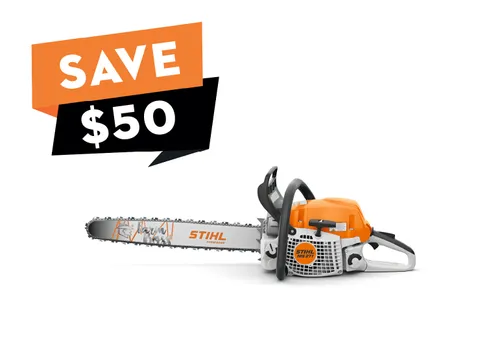
MS 271 Farm Boss
Best OverallMid-range

1. MS 271 Farm Boss

STIHL

$479–$559

The default answer for a working property, and it has held that spot for a decade for good reasons. A 50.2cc engine, a side-access chain tensioner, and a dealer network that stocks every part make it the saw most likely to still be running in fifteen years.

Best for: The one gas saw a firewood-burning homestead should own if it only buys one

Strong low-end torque for bucking hardwood at 18 or 20 inches · Side-access chain tensioner adjusts without pulling the bar cover fully · Pre-separation air filtration keeps service intervals long in dusty conditions · Sold and serviced only through dealers, so parts and warranty work are local

At 12.4 pounds bare it is noticeably heavier than a pro saw of the same displacement · No dealer-free purchase option, so rural buyers without a nearby STIHL dealer should look elsewhere

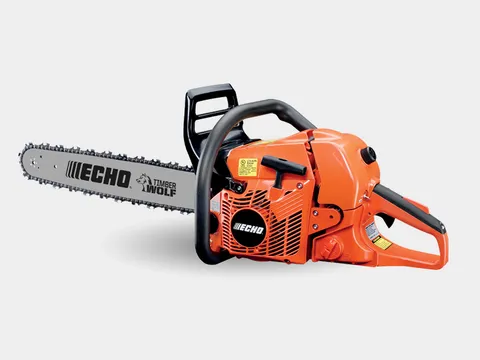
CS-590 Timber Wolf
Best ValueMid-range

2. CS-590 Timber Wolf

ECHO

$449–$489

Nearly 60cc for farm-saw money, with a five year consumer warranty behind it. On raw cubic centimeters per dollar nothing in the class comes close, and it will pull a 20 inch bar through oak without complaint.

Best for: Anyone who wants the most engine per dollar for firewood and storm cleanup

59.8cc gives it meaningful headroom over 50cc rivals at a similar price · Five year consumer warranty, which is unusually long for a gas saw · Available in 18, 20, and 24 inch bar configurations · 13.2 pounds dry is competitive for the displacement

Vibration is more noticeable than on a pro saw over a long day · Fuel consumption is higher than the 50cc class, so plan on more stops

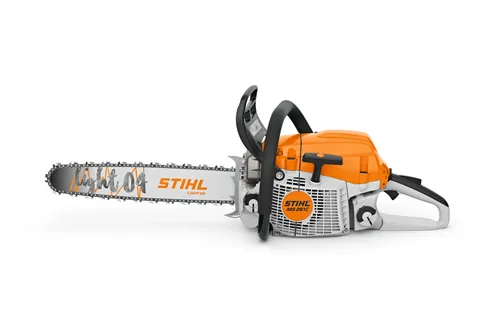
MS 261 C-M
Best PremiumPremium

3. MS 261 C-M

STIHL

$700–$780

The same 50cc class as a Farm Boss with a pound and a half stripped out and a magnesium case underneath. M-Tronic engine management retunes itself for altitude, temperature and a dirty filter, which is exactly the variability a farm throws at a saw.

Best for: Homesteaders cutting eight or more cords a year who feel it in their hands

10.9 pounds bare, about 1.5 pounds lighter than the MS 271 at the same displacement · M-Tronic removes carburetor adjustment entirely across seasons and elevations · Magnesium crankcase and full parts availability make it genuinely rebuildable · Anti-vibration system is a clear step up for long cutting days

Roughly $250 more than a farm saw that fells the same trees · M-Tronic needs a proper break-in and clean fuel to behave, so it punishes neglect

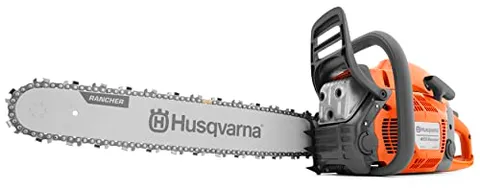
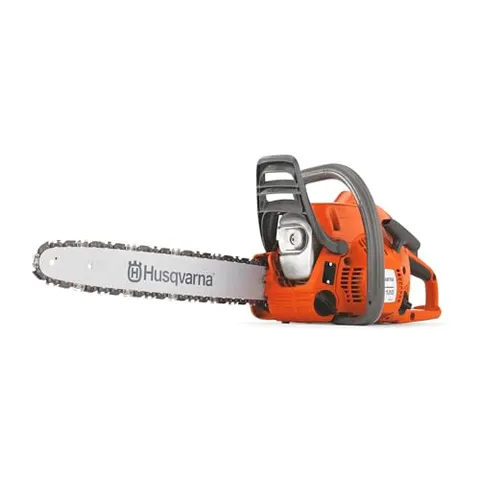
455 Rancher
Mid-range

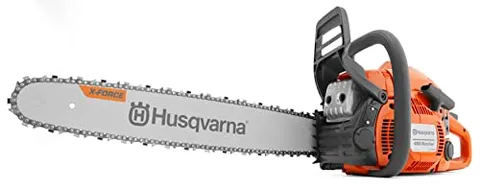
4. 455 Rancher

Husqvarna

$450–$550

The 55.5cc X-Torq Rancher is the classic answer for properties with real timber, and unlike the STIHL you can order it without finding a dealer. It ships with a 20 inch bar and will take up to 24.

Best for: Small farms with mature hardwood that want a 20 inch saw they can buy online

3.5 horsepower from 55.5cc handles 20 inch hardwood without bogging · Smart Start and a decompression valve make cold starts genuinely easy · Quick-release air filter simplifies the one service task people skip · Widely available online and at farm retailers, no dealer trip required

13.2 pounds bare makes it tiring for overhead limbing · Consumer warranty is shorter than ECHO's five years · Chain tensioner is less convenient than the side-access designs

POWER+ CS2005 20-Inch Chain Saw
Editor's PickMid-range

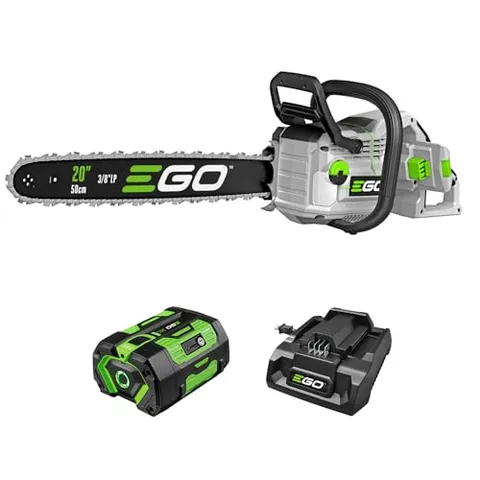
5. POWER+ CS2005 20-Inch Chain Saw

EGO

$449–$549

The first cordless saw that a farm can treat as a primary tool rather than a convenience. Chain speed reaches 25 m/s, which puts it level with a 55cc gas saw, and it does that at a volume you can run beside occupied cabins.

Best for: Agritourism operators and anyone doing frequent cutting near guests, livestock, or buildings

Cuts at gas-saw pace, with roughly 135 cuts through 6x6 stock on the included 6.0Ah pack · Three selectable speeds let you trade power for runtime on a long trail day · Instant starts after weeks of sitting, which is where seasonal gas saws fail · Five year tool warranty and a battery platform that covers mowers and blowers

19.4 pounds with the 6.0Ah battery installed, heavier than any gas saw here · A full firewood day needs several packs, and spares are expensive · Runtime drops sharply in the highest power mode

450 Rancher
Mid-range

6. 450 Rancher

Husqvarna

$320–$400

The 455's smaller sibling gives up about five cubic centimeters and often sells for $150 less, which makes it the sweet spot for properties whose wood tops out around 20 inches. Same X-Torq engine family, same 20 inch bar.

Best for: Homesteads that cut two to four cords a year and want to spend the savings on safety gear

Frequently discounted into the $320 to $360 range, undercutting the whole farm-saw class · 3.2 horsepower is plenty for standing dead ash, pine, and most storm cleanup · Shares consumables and service parts with the widely stocked Rancher line · X-Torq engine cuts fuel use and emissions against older designs

Noticeably slower than the 455 or CS-590 in wood over 20 inches · Clamshell-style construction limits how far a rebuild can go

550 XP Mark II
Premium

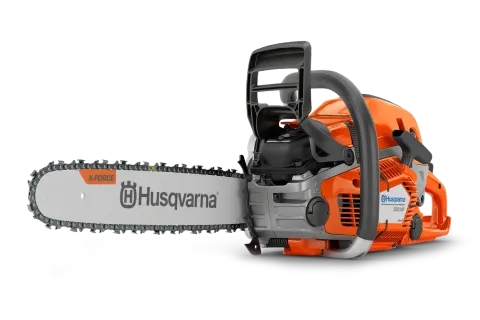
7. 550 XP Mark II

Husqvarna

$690–$780

Husqvarna's professional 50cc saw, and the closest direct rival to the MS 261. Four horsepower out of 50.1cc at 11.7 pounds bare is an outstanding ratio, and AutoTune handles the carburetion for you.

Best for: Small-farm operators who also do paid tree or lot clearing work

4 horsepower from 50.1cc, the strongest output in the 50cc class here · 11.7 pounds bare keeps it manageable for limbing and overhead work · AutoTune adjusts for fuel, altitude and filter condition with no wrenching · Two year commercial warranty coverage

Sold through dealers, so service depends on how close your nearest one is · Tuned for professional duty cycles, which is more saw than a two-cord year needs

MSA 300 C-O
Premium

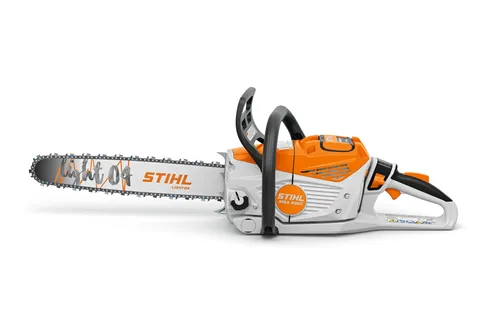
8. MSA 300 C-O

STIHL

$810–$1,380

The most capable battery chainsaw currently sold, roughly equivalent to a 50cc gas saw and a genuine substitute for a Farm Boss on properties where noise and fumes are a business problem. It is priced like the pro tool it is.

Best for: Working operations that need gas-class cutting without gas-class noise, fumes, or startup ritual

Keeps pace with a 50cc gas saw across hardwood species in independent testing · Three power levels let you trade cutting speed for meaningful extra runtime · Works with the AR backpack batteries through an adapter for all-day trail work · Available with 16, 18, or 20 inch bars

Around $810 for the bare tool, and a battery-and-charger kit pushes past $1,300 · Runtime on a single AP pack is short next to a tank of fuel · Locked to the STIHL AP battery platform, which is expensive to buy into

120 Mark III
Best BudgetBudget

9. 120 Mark III

Husqvarna

$199–$249

The entry point that is still worth owning. A 38cc X-Torq engine with a 16 inch bar handles fence lines, brush, and small firewood, and it costs less than a decent pair of chaps plus a helmet.

Best for: A second light saw, or a first saw for a property with mostly brush and softwood

Around $200 to $250, which leaves budget for real safety gear · X-Torq engine and automatic oiler are the same technology as the Rancher line · Light enough for extended limbing and one-hand-height pruning cuts · Widely stocked online and at farm retailers

38cc runs out of breath quickly in hardwood over 12 inches · Clamshell construction means it is a replace-not-rebuild tool · Not built for sustained firewood production

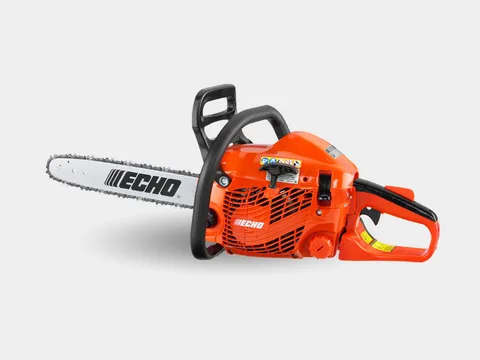
CS-310
Budget

10. CS-310

ECHO

$200–$230

A 30.5cc, 14 inch saw with a professional-grade two-stroke engine and ECHO's i-30 reduced-effort starter. It is the small saw to buy if you want something that will still start after a winter in an unheated barn.

Best for: Orchard pruning, fence lines, and trail maintenance where a big saw is the wrong tool

i-30 starting system cuts pull effort substantially, which matters for a saw that sits idle · Side-access chain tensioner is rare at this price · Clutch-driven automatic oiler stops wasting bar oil at idle · Backed by ECHO's dealer network and long consumer warranty

14 inch bar and 30.5cc limit it to brush, pruning, and small rounds · Not a firewood saw in any serious sense

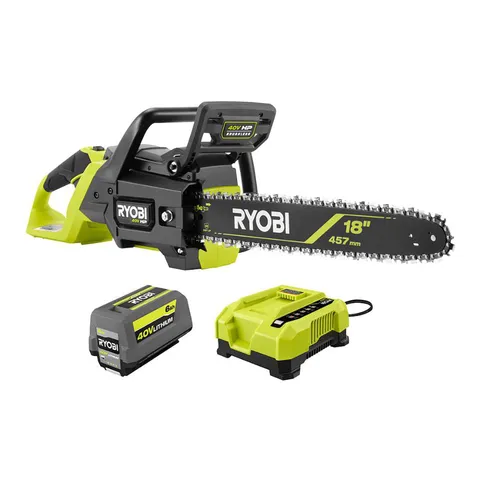
40V HP Brushless 18 in. Chainsaw Kit (RY40HPCW01K)
Budget

11. 40V HP Brushless 18 in. Chainsaw Kit (RY40HPCW01K)

RYOBI

$349–$379

The cheapest way onto a serious cordless platform. An 18 inch bar, a brushless motor rated above a 40cc gas saw, and a 6.0Ah battery in the box for under $400 is a lot of capability for cleanup duty.

Best for: A first cordless saw for storm cleanup and chores near buildings on a tight budget

Complete kit with a 6.0Ah battery and rapid charger for well under $400 · 18 inch bar is unusually long for the price on a cordless saw · Ryobi's 40V platform is broad, so the battery has other jobs on a property · Tested competitively against far more expensive cordless saws

Cuts noticeably slower than the EGO or STIHL cordless saws in hardwood · Around 90 cuts per charge, so a real work session needs a spare pack · Consumer-grade build rather than a tool for daily commercial use

572 XP
Premium

12. 572 XP

Husqvarna

$1,200–$1,350

Overkill for most homesteads and exactly right for a few. If your property has 30 inch oaks or you clear standing timber for others, 70.6cc and 5.8 horsepower at 14.5 pounds is a combination nothing in the farm class approaches.

Best for: Properties with genuinely large timber, or owners who also do paid clearing work

5.8 horsepower from 70.6cc, with a wide usable RPM band for big bars · 14.5 pounds bare is remarkably light for the displacement · AutoTune, Air Injection, and heavy-duty filtration built for all-day duty · Handles 24 to 28 inch bars comfortably

About $1,350 at MSRP, roughly three times a capable farm saw · Too much saw for limbing and small-diameter work · Fuel and chain costs scale with the extra capacity

How we choose

We built this list from manufacturer specifications, published dealer and retailer pricing current as of September 2026, and independent test coverage from outlets that actually run saws through timed cuts rather than restating press releases. Ranking reflects how well a saw suits homestead and small-farm work specifically, which weights durability, parts availability through a local dealer network, power-to-weight, and whether the price matches the hours the tool will realistically see. Tiers are drawn on construction and intended duty rather than on cutting capacity alone: budget covers homeowner-grade saws under roughly $400 that handle limbing, storm cleanup, and light firewood, mid covers the $400 to $650 farm and ranch class built for regular cord-cutting, and premium covers professional saws above roughly $700 with magnesium cases, serviceable engines, and warranties written for commercial use. Ranking is by overall recommendation for this audience, not by price, which is why a mid-tier saw sits at the top. We buy or borrow nothing from manufacturers in exchange for placement, no brand paid for a position on this list, and no ranking was adjusted for commercial reasons. Some links may earn a commission, which never changes what appears here or in what order.

Common questions

Match the bar to the wood you cut most often, not to the biggest tree you can imagine. A bar should reach at least three quarters of the way through a typical trunk, and you can fell wood roughly twice your bar length with proper technique. For most small farms an 18 or 20 inch bar on a 50cc to 60cc saw covers everything from fence-line brush to a 30 inch oak. Going longer costs you real power at the chain, because the same engine now has to pull more cutters through the cut. If you regularly work in wood over 30 inches, buy a second, larger saw rather than hanging a 28 inch bar on a farm saw.

Battery has caught up in cutting speed and has not caught up in endurance. The best cordless saws now match a 50cc to 55cc gas saw cut for cut, which surprises people who last tried one five years ago. What they cannot do is run for six hours on a firewood day without a stack of expensive packs or a backpack battery. The practical split for most properties: a cordless saw for limbing, trail work, chores near buildings and guests, and anything you do more than once a week, plus a gas saw for felling days and firewood weekends. If you can only own one and you burn wood, buy gas. If you can only own one and you mostly clean up, buy battery.

Sometimes, and the reason is not speed. A pro saw of the same displacement typically weighs two to three pounds less than a farm saw, isolates vibration far better, and can be fully rebuilt rather than scrapped when the crankcase wears. Over ten cords a year, those pounds and that vibration are what decide whether you finish the day. If you cut two or three cords a year, a farm and ranch saw is the honest answer and the extra $250 belongs in chaps, a helmet, and a decent felling wedge. If you cut ten or more, or if hand and wrist fatigue is already a factor, the pro saw pays for itself in comfort long before it pays for itself in parts.

Budget 40 to 60 percent of the saw price again for the things that make it usable and survivable. Chaps run $70 to $150, a forestry helmet with face screen and hearing protection runs $50 to $120, and both are non-negotiable on a property where help may be twenty minutes away. Add two spare chains at $25 to $35 each, a bar wrench, a file kit or a bench sharpener, a five gallon can of premixed or ethanol-free fuel, bar oil, and a set of plastic felling wedges. Cordless owners should also plan on a second battery, which on premium platforms can cost as much as the bare tool.

Less than people fear, as long as it is consistent. Sharpen or swap the chain whenever it stops throwing chips and starts throwing dust, which on dirty storm wood can be twice in a morning. Clean the air filter at the end of each cutting day. Check bar rail wear and flip the bar every few tanks so it wears evenly. Replace the spark plug and fuel filter annually. The single biggest killer of seasonal gas saws is stale pump fuel with ethanol in it, so either run canned premixed fuel or drain the tank and run the carburetor dry before the saw sits for more than a month. Cordless saws remove most of that list but still need chain sharpening, bar oil, and batteries stored at partial charge somewhere that does not freeze.

Most working homesteads settle on two, and the pairing is almost always a light saw and a heavy saw rather than two of the same size. A 14 or 16 inch saw handles pruning, brush, fence lines, and anything you do one-handed on a ladder, which is where a heavy saw gets people hurt. A 20 inch, 50cc to 60cc saw handles felling and bucking. Buying one saw to split the difference gives you something too heavy for the frequent job and too small for the hard one. If budget forces a single purchase, buy the farm and ranch saw and accept that the small chores will be tiring.

Some links are affiliate links, and we may earn a commission at no extra cost to you. It never affects our rankings.

In your pocket

Take farm country with you.

Free, no account needed. Farm maps, season checklists, and the crop identifier in your pocket.

  • Every farm stand and u-pick in your pocket

  • Plan a multi-stop farm day and save it

  • Snap a photo. AI names the crop

  • GPS tracking that keeps recording down the county road

The Farm Country Hubs app dashboard

For operators

Run a farm business?
Get on the map for free.

Claim your free listing for a branded page and a spot in the Farm Country Hubs app, then add bookings and digital waivers whenever you’re ready. No setup cost.